Categories
Blog

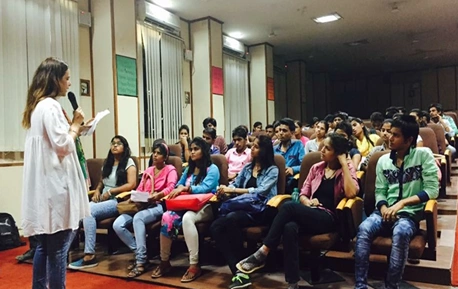
How Often Should You Conduct POSH Training 

Many organizations conduct one POSH training session a year and consider the job done. But is that really enough? 

The answer is not always.

While the POSH Act, 2013 requires employers to create awareness about workplace sexual harassment, leading organizations often conduct quarterly POSH awareness sessions to keep employees informed, reinforce workplace values, and strengthen compliance. 

What’s the Ideal Training Frequency?

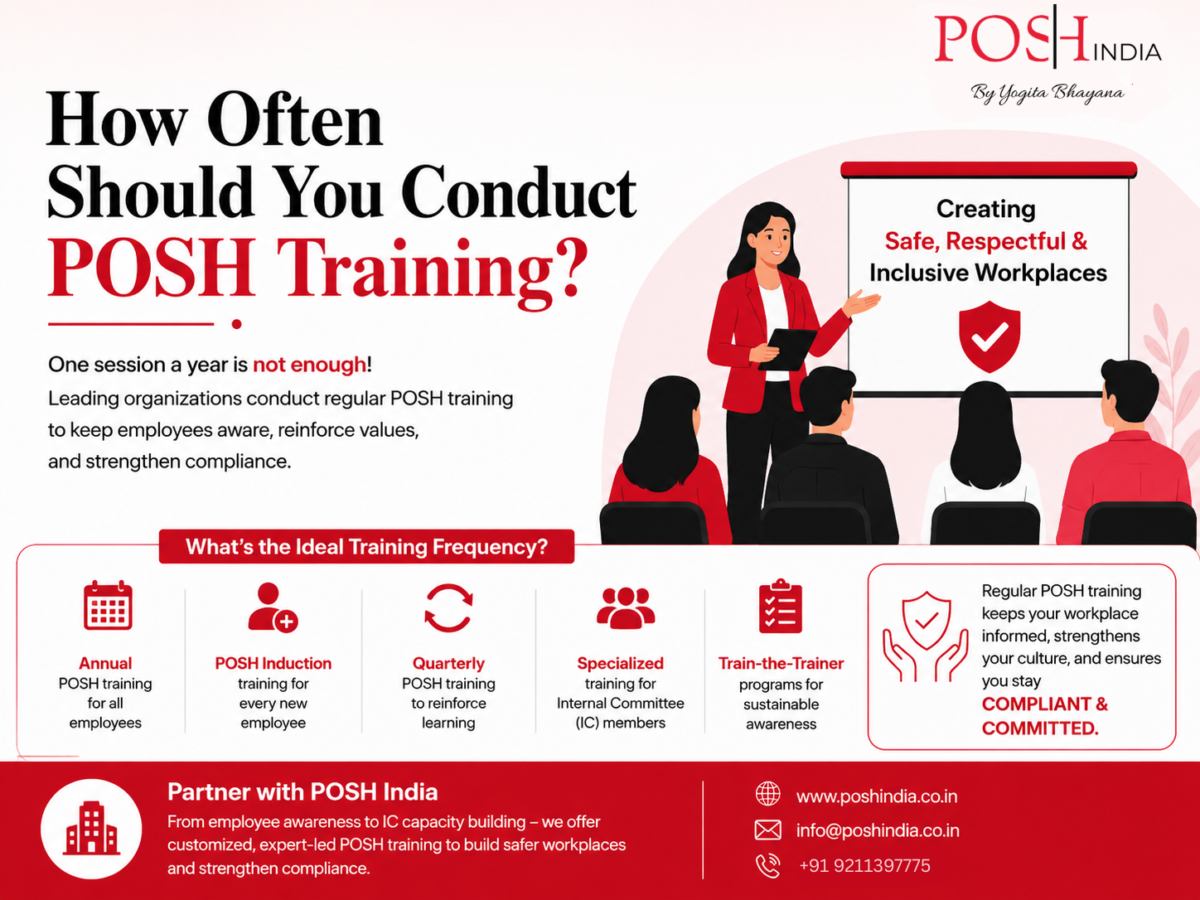
A strong POSH awareness program should include:

  • Annual POSH training for all.
  • POSH induction training for every new employee.
  • Regular quarterly POSH training to reinforce learning and keep employees informed 
  • Specialized training for Internal Committee (IC) members to help them handle complaints effectively.

This ensures that POSH awareness becomes a part of your workplace culture—not just a compliance activity.

Why Regular POSH Training Matters

As workplaces grow and evolve, regular POSH training keeps employees aware of acceptable workplace behavior, reporting procedures, and organizational expectations. More importantly, it reinforces your commitment to creating a safe, respectful, and inclusive workplace—not just staying compliant. 

Partner with POSH India

At POSH India, we believe effective POSH training should be engaging, practical, and tailored to your organization’s needs. Our expert-led programs include employee awareness sessions, manager training, Internal Committee capacity building, and Train-the-Trainer certification to help organizations build safer workplaces and strengthen compliance.

If you’re looking to strengthen your POSH compliance, POSH India is here to help with customized training and expert guidance for organizations across industries.

Categories
Blog

Don’t Wait Until Year-End: It’s Time to Complete Your POSH Training

Don’t Wait Until Year-End: It’s Time to Complete Your POSH Training

With only a few months left in 2026, now is the perfect time to review your organization’s POSH compliance efforts.

Many organizations postpone POSH training until the end of the year, but regular awareness and capacity-building are essential for creating a safe and respectful workplace. While having a POSH policy and an Internal Committee is important, employees, managers, and committee members must also be equipped with the right knowledge to fulfil their responsibilities effectively.

Build Internal POSH Experts with POSH India’s TTT Program

At POSH India, we help organizations go beyond basic compliance through our Train the Trainer (TTT) Program. Designed for HR professionals, leaders, Internal Committee (IC) members, and L&D teams, the program equips participants with practical knowledge and confidence to lead POSH awareness initiatives within their organizations.

What We Offer

Our specialized TTT program covers:

  • Comprehensive training on the POSH Act and organizational policies
  • Advanced facilitation and presentation techniques
  • Use of real-life scenarios, activities, and interactive tools
  • Guidance on handling challenging questions and sensitive topics
  • Certification upon successful completion

By training your internal teams, your organization can build long-term capability, strengthen compliance, and foster a culture of respect throughout the year.

Take Action Before the Year Ends

Don’t wait until December to complete your POSH training. Empower your HR and leadership teams with the knowledge and skills they need to create a safer, more compliant workplace.

Connect with POSH India today to learn more about our specialized POSH Train the Trainer (TTT) Program and build internal POSH champions for your organization.

Categories
Blog

What Every Employer Should Know About NCW POSH Compliance


Every work environment must be a place where individuals feel respected, appreciated, and secure. This is the message that the National Commission for Women (NCW) emphasizes through its latest recommendations on enhancing POSH compliance.

For numerous organizations, having a POSH policy and an Internal Committee is already part of the NCW POSH compliance requirements. However, the NCW’s message is unmistakable: compliance must extend beyond mere documentation. It needs to become part of the daily culture of the workplace.

A safe work environment comes through action. Employees should know where to report issues, Internal Committees should operate effectively, organizations must handle complaints fairly and confidentially, and regular awareness sessions should help everyone understand their rights and responsibilities.

The recent recommendations on annual POSH audits encourage organizations to review how well their existing systems actually work. Instead of waiting for a complaint or an external review, employers have an opportunity to identify gaps, improve processes, and strengthen employee trust.

This is not just about meeting legal requirements. It is about creating an environment where employees feel confident that their concerns will be heard and addressed with fairness and sensitivity.

Categories
Blog

NCW Recommends Annual POSH Audits to Improve Workplace Safety 

NCW Recommends Annual POSH Audits to Improve Workplace Safety 

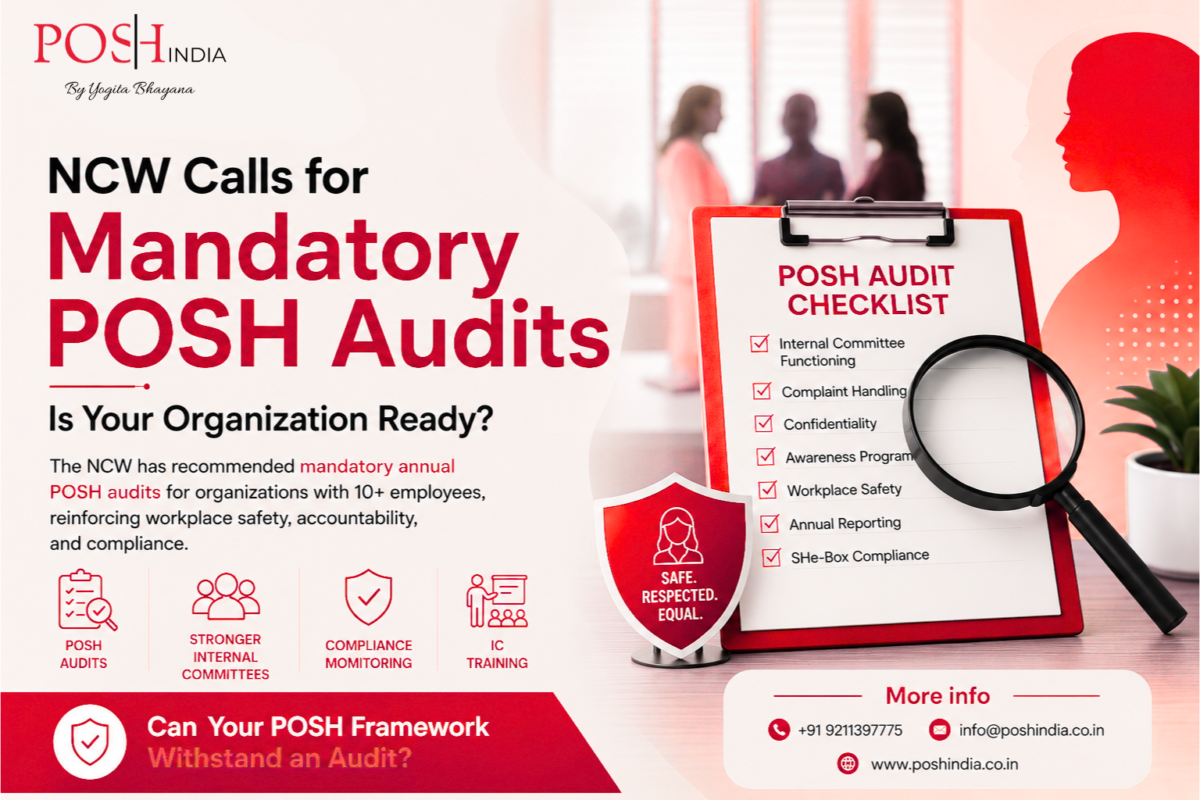
The National Commission for Women (NCW) has urged organizations with ten or more employees to conduct annual POSH audits. This emphasizes the importance of workplace safety and accountability. The recommendation makes it clear that having a policy or an Internal Committee (IC) is not enough; these mechanisms must work effectively.

Why This Matters  

Many organizations think they are POSH compliant because they have an IC and a policy. However, true compliance requires regularly reviewing complaint handling processes, keeping confidentiality safeguards in place, implementing employee awareness programs, ensuring workplace safety measures, meeting annual reporting obligations, and assessing how Internal Committees function.

What the NCW Recommends  

  •  Mandatory Annual POSH Audits  
  •  Stronger Internal Committees  
  •  State and District-Level Monitoring  
  •  IC Member Training  
  •  Protection Against Retaliation  
  •  Greater Transparency and Compliance  

What Organizations Should Do  

Organizations should take this chance to evaluate their current POSH framework. They need to make sure their Internal Committees are legally constituted, enhance employee awareness and training programs, and review their reporting obligations. Being proactive now can help organizations stay compliant and be better prepared for future audits.

The Bigger Message  

The NCW’s advisory reminds us that workplace safety goes beyond just legal compliance. It shows an organization’s commitment to dignity, respect, and accountability. The question is no longer whether you have a POSH policy; it’s whether your POSH framework is genuinely ready for an audit.


Categories
Blog

National CME cum Workshop, Panchkula: Advancing Workplace Safety in Healthcare

National CME cum Workshop, Panchkula: Advancing Workplace Safety in Healthcare

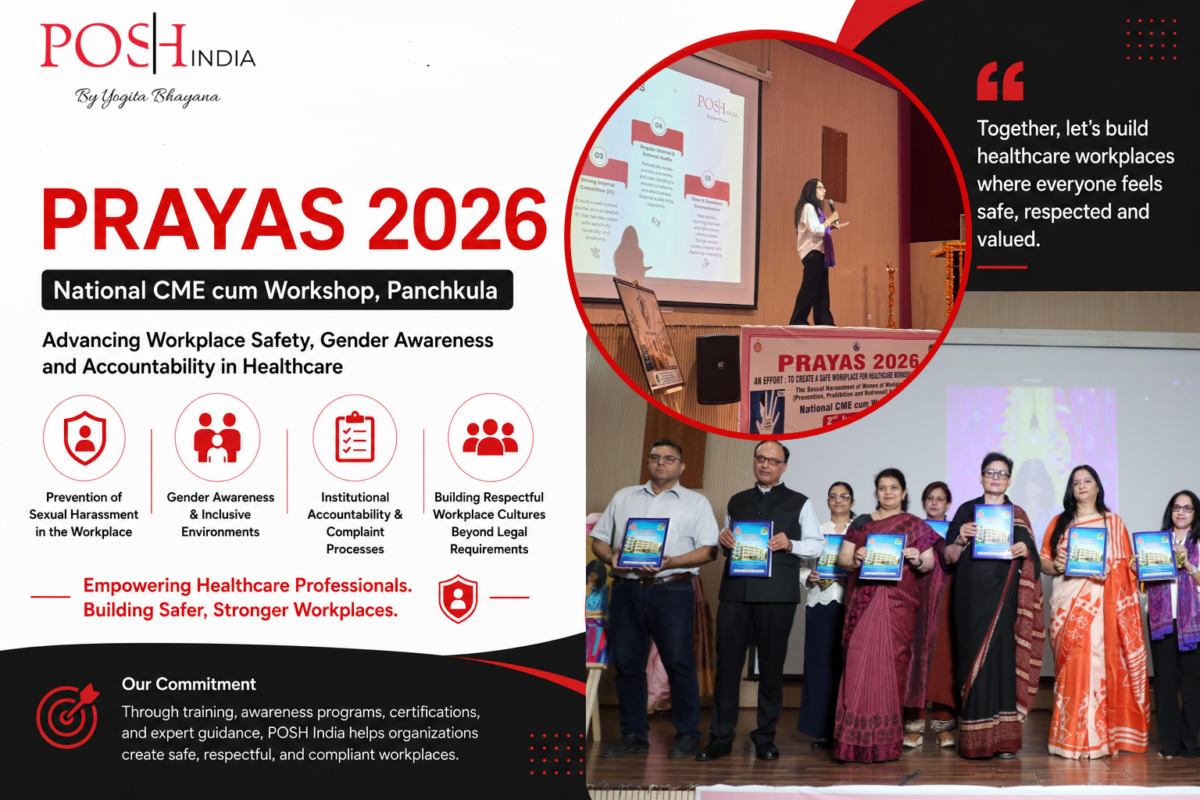
Creating safe, respectful, and inclusive workplaces is crucial, especially in healthcare, where professionals work in high-pressure situations. On 2nd June 2026, POSH India took part in PRAYAS 2026, a National CME cum Workshop in Panchkula. This event focused on workplace safety, gender awareness, and accountability.

A representative from POSH India was invited as a Key Speaker to address healthcare professionals, educators, and administrators. The talk emphasized the importance of safer workplaces and following the POSH Act, 2013. The session highlighted ways to improve workplace policies, promote gender-sensitive practices, and build a culture of respect and responsibility.

Key themes discussed during the workshop included:

  •  Prevention of sexual harassment in the workplace
  •  Gender awareness and creating inclusive environments
  •  Institutional accountability and effective complaint processes
  •  Building respectful workplace cultures beyond legal requirements

The workshop offered a great chance for healthcare professionals and workplace safety advocates to share ideas, best practices, and increase awareness of workplace safety measures.

POSH India is dedicated to helping organizations through training, awareness programs, certifications, and expert guidance to create safe, respectful, and compliant workplaces. We appreciate the organizers of PRAYAS 2026 for providing a valuable platform that helps advance workplace safety in healthcare institutions.


Categories
Blog

How to Conduct a POSH Audit in Your Organization

How to Conduct a POSH Audit in Your Organization

Introduction
A POSH Audit helps organizations assess their compliance with the Prevention of Sexual Harassment (POSH) Act, 2013. It identifies gaps in policies, procedures, awareness programs,
and Internal Committee (IC) functioning, ensuring a safer and legally compliant workplace.

Steps to Conduct a POSH Audit

1. Review POSH Policy
First, verify whether the organization has a comprehensive POSH policy that aligns with the requirements of the POSH Act, 2013. Ensure the policy is accessible to all employees.

2. Assess Internal Committee (IC) Compliance
Next, check if the Internal Committee has been properly constituted, including the required members and external experts. Review appointment letters and tenure details.

3. Examine Training and Awareness Programs
Evaluate whether regular POSH awareness sessions, workshops, and IC training programs have been conducted for employees and committee members.

4. Review Complaint Handling Procedures
Thereafter, assess the process for receiving, investigating, and resolving complaints. Ensure confidentiality, fairness, and timely resolution of cases.

5. Verify Documentation and Records
Further, review records of training, complaints, inquiry reports, meeting minutes, and annual reports to ensure proper documentation and compliance.

6. Check Workplace Communication
Additionally, confirm that POSH policies, IC details, and complaint mechanisms are displayed prominently and communicated effectively across the organization.

7. Evaluate Employee Awareness
Moreover, conduct surveys or interviews to determine employees’ understanding of workplace harassment, reporting mechanisms, and available support.

8. Prepare an Audit Report
Finally, document findings, identify compliance gaps, and provide recommendations for improvement. Create an action plan to rectify all the deficiencies.

Benefits of a POSH Audit
● Ensures compliance with the POSH Act, 2013.
● Identifies and addresses compliance gaps.
● Strengthens employee trust and workplace safety.
● Improves Internal Committee effectiveness.
● Reduces legal and reputational risks.

Categories
Blog

Why Internal Committee Training for POSH Compliance

Why Internal Committee Training Is Critical for POSH Compliance

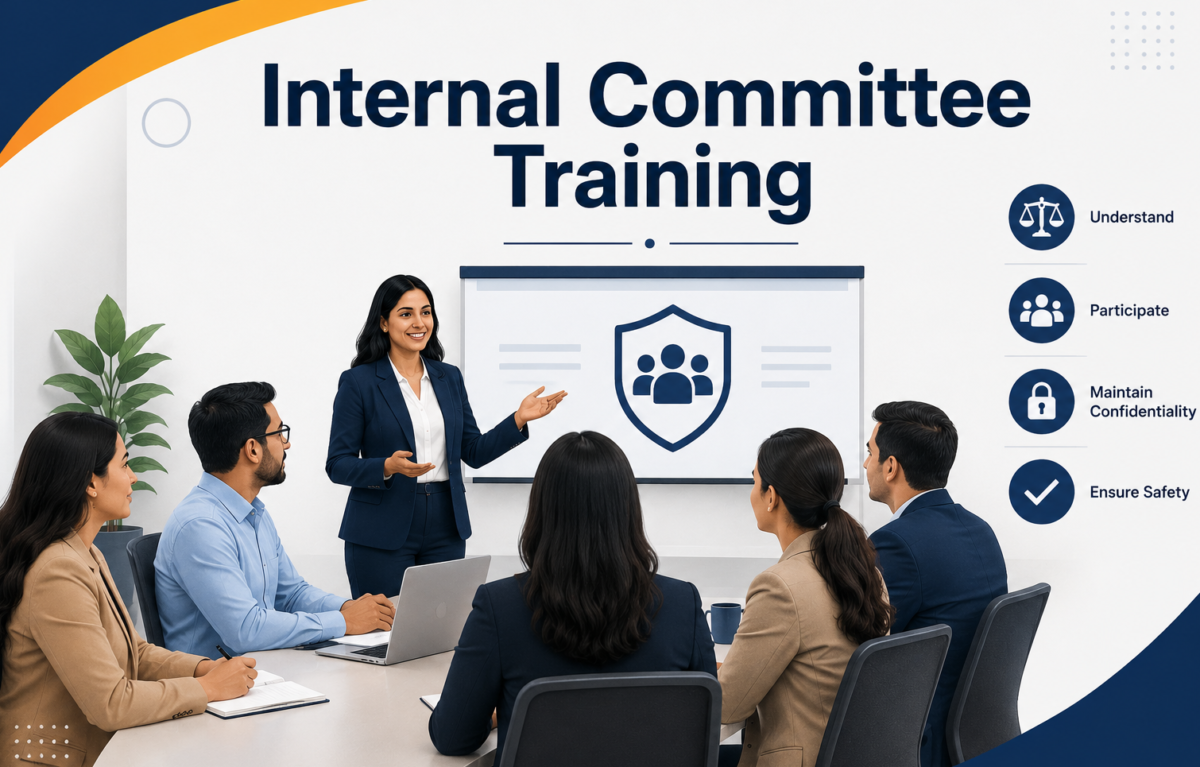
According to the POSH Act, 2013, all organizations employing ten or more individuals have to form an Internal Committee (IC) to receive complaints of workplace sexual harassment. However, mere formation of IC is not sufficient; its members need to be trained sufficiently to receive complaints, process them properly, and deal with any issues related to them.

A properly trained IC can play a vital role in handling complaints, making inquiries into them, maintaining confidentiality, being compliant with various legalities, and making suitable recommendations regarding such complaints.

Areas of Training for IC Members
• POSH Act, 2013 and responsibilities of an employer
• Membership in an IC and their functions
• Handling complaints and conducting inquiries
• Natural justice principles
• Keeping proper documentation
• Maintaining confidentiality
• Preparing reports and recommendations
• Real-life case scenarios

Benefits of Internal Committee Training

  • Strengthens legal compliance
  • Ensures fair and effective inquiries
  • Builds employee trust and confidence
  • Reduces compliance and reputational risks
  • Promotes a safe and respectful workplace culture

Regular training is essential to keep IC members updated on legal developments, workplace challenges, and best practices in complaint management.

An empowered Internal Committee is the foundation of an effective POSH framework and a safer workplace.

Categories
Blog

POSH Certification : Advantages for HR, Managers &Organizational

Our Services

POSH Certification : Advantages for HR professionals, Managers, and Organizational

The POSH Act, 2013 mandates organizations to create a safe, respectful, and harassment-free workplace. POSH Certification equips HR professionals, managers, and organizational leaders with the knowledge and skills required to effectively implement the Act and foster a positive work culture.

One way of making sure that all measures have been taken and creating a positive working environment is by getting the POSH certification. As an HR professional or manager, it is important for you to get the POSH certification.

It will provide you with the skills and knowledge required to deal with workplace issues.

Harassment in the workplace can cause psychological, emotional, financial, social, reputational, and organizational impacts.

Benefits for HR Professionals

  • Comprehensive understanding of the POSH Act and employer responsibilities.
  • Effective complaint handling, investigations, and confidentiality management.
  • Stronger policy implementation, awareness, documentation, and compliance reporting.
  • Enhanced ability to support employees and maintain workplace dignity.

Benefits for Managers

  • Early identification and prevention of workplace misconduct.
  • Improved leadership through empathy, respect, and effective communication.
  • Better guidance and support for employees facing workplace concerns.
  • Promotion of an inclusive and gender-sensitive work environment.

Benefits for Organizations

  • Stronger legal compliance and risk mitigation.
  • Increased employee trust and confidence.
  • Improved workplace culture and employee engagement.
  • Enhanced employer brand and reputation.
  • Reduced workplace conflicts and higher employee retention.

POSH Certification is not just about compliance—it is about creating workplaces built on respect, safety, and accountability.

Categories
Cases

Kerala HC Declared the Belief That Indian Women Wouldn’t Make False Sexual Assault Allegations as Outdated

Facts of the Case

The petitioner was accused of committing rape on the de facto complainant by promising marriage between 2014 and
2019. The de facto complainant alleged that the petitioner subjected her to rape during this period. The
petitioner and the complainant were in a consensual relationship, with the alleged incidents of rape supposedly
occurring between May 30, 2014, and April 20, 2019. However, the FIR was filed only in 2019, raising concerns
about the credibility of the complaint, especially considering that there had been no contact between the
parties for over three years before the complaint was made.

Contention of the Petitioner

The petitioner contended that the allegations of rape were baseless. He argued that the sexual relations between
him and the de facto complainant were consensual, and that there was no coercion involved. He pointed out the
significant delay in filing the FIR (five years after the alleged incident) and noted that there had been no
contact between the petitioner and the complainant for over three years. Moreover, the petitioner referred to
the fact that the complainant had previously filed a complaint with the Women Cell in 2016 but had withdrawn it
after receiving assurances from him regarding marriage. He claimed that this behaviour indicated that the
complainant’s allegations were motivated by ulterior motives, possibly related to personal grudges or attempts
to exert pressure for illegal demands.

Contention of the Respondent

The respondent (the de facto complainant) maintained that she had been subjected to rape by the petitioner, who
had promised to marry her. She claimed that the sexual relations were non-consensual, and that the petitioner
had taken advantage of her trust. The respondent pointed out that the petitioner’s actions caused her
significant emotional and psychological harm, and the failure to file the FIR earlier was attributed to her
belief that the petitioner would eventually marry her, as assured by him on several occasions. She further
argued that the delay in filing the complaint should not be considered as an indication that her allegations
were false.

Court’s Observation

The Kerala High Court noted a significant shift in how society perceives sexual assault allegations, particularly
in the context of Indian society. The Court observed that the old belief—that women would not make false
allegations of sexual assault due to societal pressures—no longer held universally true. The Court stated,
“In cases where sexual assault has been alleged, the said concept has been carried for the past so many
years, on the premise that, in Indian society, any girl would not make any allegation of sexual assault or
any other mode of misconduct against a person… However, in recent years, this concept seems to be diluted…
so as to settle a score and also to compel the persons against whom allegations are made to heed the illegal
demands of the complainants.”

The Court also referred to the Supreme Court’s judgment in Wahid Khan v. State of Madhya Pradesh (2010),
noting that traditionally, girls in India were reluctant to admit incidents of sexual assault because they
feared social ostracism. However, the Court pointed out that these concerns should not lead to blind acceptance
of allegations without scrutinizing the facts of each case individually. It observed that in the present case,
the delay in filing the FIR, coupled with the lack of contact between the parties for three years, raised doubts
about the credibility of the complaint.

Court’s Decision

The Court ultimately quashed all the proceedings against the petitioner, citing a lack of substantive evidence to
support the allegations of rape. The Court reasoned that the relationship between the petitioner and the de
facto complainant was consensual, and the overt acts alleged in the complaint could not be classified as rape.
The delay in filing the complaint, combined with the fact that the complainant had not pursued earlier
complaints, further supported the Court’s conclusion that the allegations lacked merit. The Court emphasized
that the consent of the complainant had not been vitiated by any misconception of facts and that the
relationship was purely consensual in nature.

The Court also took into account the complainant’s affidavit, which stated that she had no objection to quashing
the proceedings against the petitioner. As a result, the Court allowed the petition for quashing and dismissed
the criminal proceedings, stating, “Therefore, the relationship between the defacto complainant and
petitioner was purely consensual in nature… no materials made out in this matter to attract the offence
punishable under Section 376 of IPC.”
The proceedings in the Sessions Court, arising from the case,
were accordingly quashed.

Categories
Cases

Kerala High Court observed that a Complainant who raises a complaint should be entitled to ensure that her whereabouts are anonymised from the public domain

Facts of the case

The Petitioner during his service as a Deputy Director in the District Tourism Office faced an enquiry which was
initiated against him by Internal Committee (IC) under the Sexual Harassment of Women at Workplace (Prevention,
Prohibition and Redressal) Act, 2013 based on a complaint from a female employee. The allegation against the
Petitioner is that he harassed the Complainant, a female co-worker in various ways. A Show Cause Notice was
issued to the Petitioner by which a punishment of lowering him as the junior most in the category of Tourist
Information Officer was tentatively proposed.

The Petitioner submitted a reply raising serious objection against the enquiry report and the proposed
consequential actions. The Petitioner then approached the Kerala Administrative Tribunal for setting aside the
report and further proceedings. The Kerala Administrative Tribunal refused to interfere with the proceedings
initiated against the Petitioner stating that the objection raised by the Petitioner is premature and he could
avail of his remedies when final orders are issued.

This Kerala Administrative Tribunal Order has been challenged before the Hon’ble Kerala High Court through
Petition filed under Article 227 of the Constitution of India.

Contentions of the Petitioner

The contention of the Petitioner is that the IC is bound to enquire into the complaint in accordance with
the provisions of the service rules applicable, yet the Petitioner was denied participation in the enquiry, and
he was not given an opportunity to cross examine the Complainant. It was further contended by the Petitioner
that the enquiry should have adhered to service rules applicable to him under Kerala Civil Services
(Classification, Control and Appeal) Rules. The Petitioner further contended that the procedure followed by the
IC violates the second provisio to Section 11 of the POSH Act. The Petitioner placed reliance on Sibu L.S. v.
Air India Ltd., New Delhi and Other.

Court’s Observations

The Court observed that the procedure to be followed in such enquiry must be the procedure prescribed under the
Kerala Civil Services (Classification, Control and Appeal) Rules or such other departmental rules applicable to
the employee.

However, before allowing the delinquent to cross-examine the victim of sexual harassment, the committee must
ensure her capability to depose before them fearlessly and without intimidation. The Court also observed that
the mere fact that the Petitioner was not permitted to verbally cross examine the victim, cannot be said that
the enquiry is vitiated. The court pointed out that a delinquent should not be permitted to challenge the
disciplinary proceedings at an interim stage as that would cause delay to reach finality and thereby the
delinquent can challenge the final outcome.

Court Decision

The disciplinary authority should ensure that the IC proceed with enquiry in the manner provided in the Kerala
Civil Services (Classification, Control and Appeal) Rules and the Petitioner is given an opportunity to
discredit the complaint or to adduce evidence before the Committee. The Court directed that the Respondent’s
complete the entire process at the earliest within a period of 3 months from the date of receipt of this
judgment.

During hearing of this Petition, the court observed that there is no mechanism to anonymise the Complainant who
alleges that she faced sexual harassment or other atrocities as envisaged by the POSH Act. The Court emphasized
that right to privacy is recognised as one of the most important aspects of the fundamental rights of a person
and therefore a Complainant who raises a complaint is entitled to ensure that her whereabouts are anonymised
from the public domain. The Court referenced a decision of the Bombay High Court in P v. A and Ors. and
suggested to consider those guidelines with necessary variations.